The Rain in Anirban’s Head
THIS IS A WORK OF FICTION
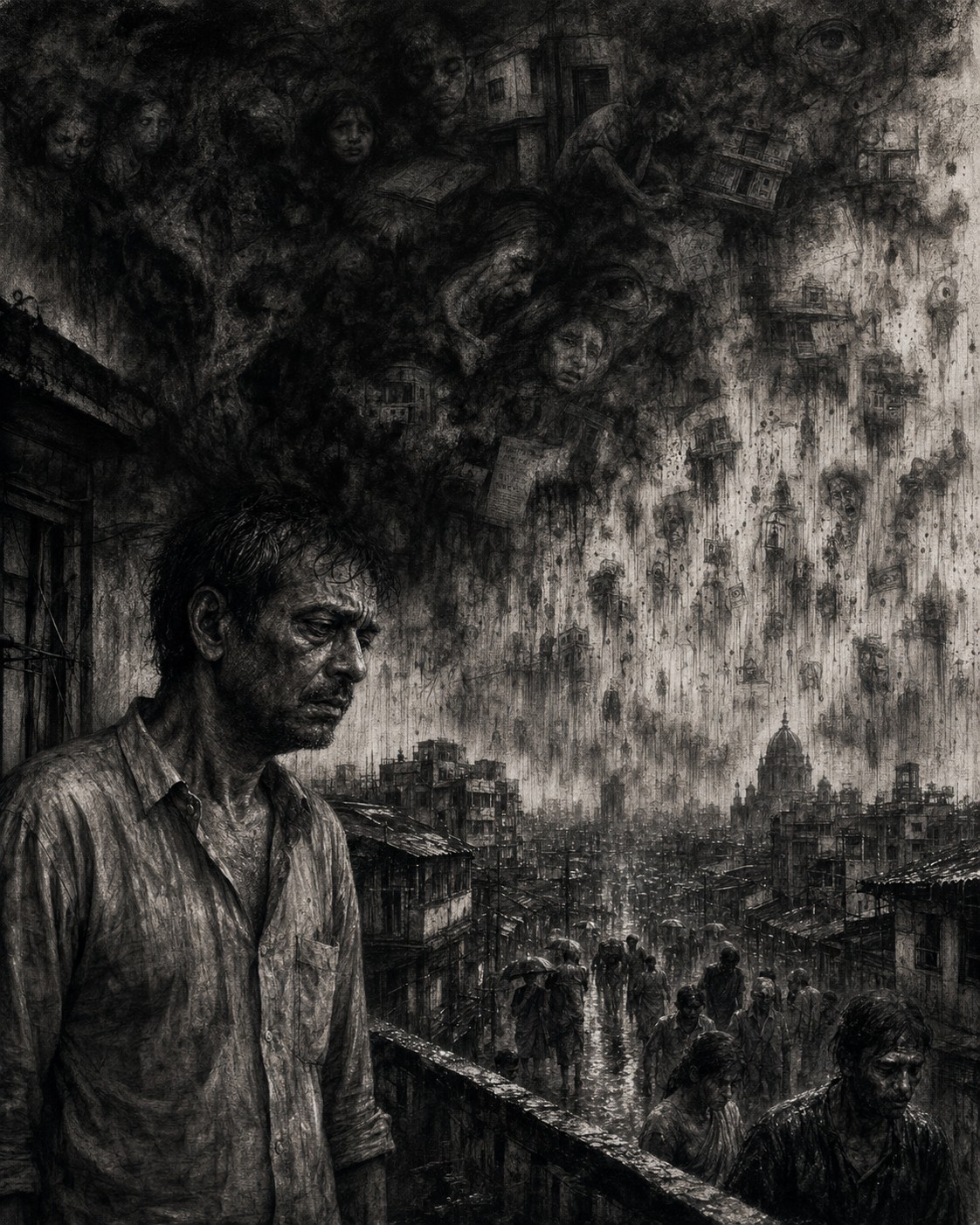
At Garia Bazar, on the morning the cloud first lowered itself over the southern fringe of Calcutta, Anirban Mitra stood beside a tea stall and watched a goat eat the corner of a coaching-center poster that promised rank, success, certainty, and air-conditioned futures.
The goat, being a practical philosopher, preferred the boy’s printed face.
Rain had fallen in the night, though the monsoon was not yet officially in the city, and the road was a shallow argument between mud, engine oil, crushed marigold, and plastic. Autos coughed green smoke. A bus leaned into the crossing like a sick elephant. Fish sellers slapped hilsa on wooden blocks with priestly violence. Above the market, tram wires from another century were absent but somehow imaginable, as if old Calcutta had left ghost lines in the air for newer humiliations to hang from.
Anirban held a clay cup of tea that had gone lukewarm. He was fifty-one, lower middle class by bank balance, middle class by education, and unemployed by the plain cruelty of the word. Once he had called himself a healthcare entrepreneur. It sounded better in hotel lobbies and worse in one-room flats. His company had promised to connect clinics, pharmacies, laboratories, and hospitals across India through clean data exchange. He had diagrams, pitch decks, architecture, and a belief that interoperability could be a kind of public hygiene.
Now he had one folding table, two unpaid interns who had stopped calling, a rented flat near the marshy edges beyond Kamalgazi, and a server bill that arrived with the punctuality of a debt collector in a Bengali novel.
“Dada, cha ta khaben, na postmortem korben?” said Bappa, the tea seller.
Anirban looked down. The tea’s surface reflected a small, dark blur above his head.
He thought it was a kite at first, or a scrap of tarpaulin caught on a cable. Then the blur thickened. It had no proper edge. It hovered three feet above him, black with a hint of purple, like old bruised jamun fruit. It moved when he moved.
Bappa stared up and gave a small laugh. “New fashion?”
Anirban stepped back. The cloud followed.
The customers at the stall turned. A delivery rider in a wet orange jacket raised his phone. A woman buying coriander pulled her child away with the practiced expression of a mother who had seen enough men in Calcutta become incidents.
“It is smoke,” Anirban said, though no smoke ever looked so loyal.
“From where?” asked Bappa. “Your head has chimney?”
A drop fell from the cloud into Anirban’s tea.
The tea went black.
Not brown. Not strong. Black.
For one second the market sound thinned, as if someone had pressed cotton into the city’s ears. Then Anirban heard his father’s cough.
It came from the cup.
A dry, irritated, winter cough from 1987, from a north Calcutta bedroom smelling of Vicks, damp books, and the kerosene stove his mother was not allowed to keep near the curtain. His father’s cough, then his father’s voice saying, “Computer science kore ki hobe? First learn how to stand straight when elders speak.”
Anirban dropped the cup. It broke at his feet.
The cloud shivered with satisfaction.
By noon, it had followed him home through the lanes, past half-built gated towers named after European flowers, past open drains where blue plastic packets sailed bravely toward no ocean, past a political poster in which every leader looked as if he had personally invented wheat. It came into his flat without touching the door frame. It rested above the bed while he sat under the fan, sweating.
His flat was on the third floor of a peeling apartment building whose balconies had iron grilles like jail experiments done on a modest budget. From his window he could see a pond gone green, a telecom tower, laundry, and the distant ribs of new construction. The city no longer ended anywhere. It just became cheaper, wetter, and more apologetic.
On his phone, the first video had already appeared.
MAN WITH PERSONAL RAIN CLOUD IN GARIA??? SUPERNATURAL OR CHEMICAL LEAK???
In the clip, he looked worse than he felt, which was an achievement. His hair was thin, his shirt damp, his face an exhausted compromise between intelligence and defeat. Above him floated the cloud.
By evening, his old friend and former co-founder, Debolina Roy, arrived with a packet of paracetamol, two masks, and the severe tenderness of a person who had known him before he became mostly absence.
She stood inside the door and looked up.
“Oh,” she said.
“That is your clinical opinion?”
“My clinical opinion is you should not stand under it.”
“I tried. It follows.”
Debolina had once run hospital operations for their little company, SomaLink Health Systems, before unpaid invoices and Anirban’s refusal to bribe a district procurement officer killed the business. She was practical, sharp-faced, forty-eight, divorced, and employed now by a private hospital near Mukundapur, where the lobby smelled of coffee and fear.
“Any smell?” she asked.
“Rain. Dust. Old paper.”
“Any pain?”
“Only the usual subscription package.”
She gave him a look.
He smiled weakly. “Sorry.”
The cloud pulsed. A fine drizzle began, not downward exactly, but outward. The drops hung in the air like tiny black beads before striking the floor, the bed, the curtain, Debolina’s wrist.
She inhaled.
Her face changed.
“Debu?”
She sat down on the plastic chair as if her knees had received bad news. Her eyes moved from the room to some private distance.
“My mother,” she said. “The day we left Behala. I told her I would come back by Durga Puja. I didn’t. She waited with payesh.”
The drizzle stopped.
Anirban did not speak. He had learned that other people’s grief should not be hurried merely because it embarrassed you.
Debolina wiped her wrist with a tissue. The stain remained under her skin, faint and grey.
“This is not only hallucination,” she said at last.
“I know.”
“Did you take anything?”
“No.”
“New medication?”
“No.”
“Sleep?”
He laughed once. “Let us not become ambitious.”
She looked at the cloud again. “What were you thinking when it appeared?”
“Nothing new. Same things. Company failure. Rent. My mother’s medical bills. My father’s voice. Whether my life has been a long, inefficient method of disappointing people.”
“Very original. Bengali men have been doing this since the Pal dynasty.”
The cloud darkened.
“Don’t joke,” Anirban said.
“Then don’t feed it.”
But he did feed it. Not deliberately. That was the trouble with rumination. It was not a meal one chose to cook. It was a damp wall that produced its own fungus.
That night there was a power cut. The fan died. The building sighed and complained in the dark. From neighboring flats came the familiar orchestra of outage: someone’s inverter beep, someone’s child crying, someone cursing the electricity board, someone dragging a chair across the floor as if furniture too must participate in democracy.
Anirban lay awake. The cloud pressed against the ceiling, broadening. In the dark, it looked almost peaceful.
At 2:17 a.m., rain began over Calcutta.
Not everywhere at once. First in the southern fringe. Then Jadavpur. Then Ballygunge. Then Esplanade. Then Howrah Bridge, where drivers switched on wipers and found that the wipers only spread the darkness more evenly.
By morning, the city was soaked.
The rain was thin and black. It left no puddles. It passed through umbrellas, tarpaulin, tin roofs, metro entrances, hospital awnings, and the glossy glass skins of new towers. It did not wet clothes, but everyone felt drenched.
At Kavi Subhash Metro, commuters froze on the platform as the announcements dissolved into voices from their own lives. A software engineer heard his Class XII mathematics teacher say, “You are not IIT material.” A young nurse outside Ruby heard her uncle whisper the family calculation that nursing was respectable enough for a daughter but not too educated for marriage. A municipal councillor in a white kurta heard the precise amount of money he had taken from a drainage contract, spoken in his dead wife’s voice.
By ten o’clock, half the city was crying, shouting, or standing perfectly still.
The news channels called it mass psychogenic weather.
The government called it an atmospheric contamination event.
The opposition called it proof of administrative collapse.
Priests, psychiatrists, influencers, meteorologists, and one retired actor in sunglasses all appeared on screen before lunch. Everyone spoke with confidence, the cheapest renewable resource in India.
Anirban watched from his bed.
Every channel showed the same thing: Calcutta under a lid of black vapor, buildings blurred, traffic stalled, people touching their faces as if checking whether they still existed. In College Street, booksellers covered their stalls with plastic, but customers stood in the rain reading pages from books they had never opened. In New Market, a butcher sobbed into a tray of chicken liver. At a mall near EM Bypass, shoppers abandoned branded bags and sat on polished floors, whispering apologies to people not present.
Then came the phone calls.
First his landlord, asking whether he had kept “some machine” in the flat.
Then a journalist.
Then Debolina.
“You need to come to the hospital,” she said.
“Why?”
“People are mentioning you.”
“Who?”
“Patients. Staff. Random people. They say the rain is in your voice.”
He looked at the cloud. It had thinned above him. Most of it, he understood with animal dread, was outside now.
“I didn’t do anything.”
“I know. Come anyway.”
He went because guilt is one of Calcutta’s most reliable transport systems. It can move a man through rain, panic, and traffic when buses cannot.
The app cab smelled of stale perfume and damp vinyl. The driver, a young man with tired eyes, kept glancing at the rearview mirror.
“Dada, you are that cloud man?”
“No.”
The driver considered this. “Okay.”
At the Ruby crossing, traffic had congealed. Autos stood nose to tail. Police blew whistles into an atmosphere that had lost interest in authority. Delivery riders huddled under a flyover, each looking at his phone, not for orders but for evidence that the world had been normal yesterday.
Outside the hospital, black rain fell through the portico. Security guards had stopped arguing with relatives. Everyone was too busy hearing themselves.
Inside, Debolina led Anirban through corridors washed in fluorescent light. The hospital, usually an efficient machine for converting terror into invoices, had become human in the worst way. A surgeon sat outside the ICU repeating, “I was tired, I was tired,” though no one had accused him. A billing executive stared at a computer screen and murmured, “Package upgrade, package upgrade,” like a broken prayer.
In a small conference room, three people waited: Debolina, a police inspector named Tapan Ghosh, and a young woman Anirban recognized after a moment as Rini, one of his former interns.
Rini had joined SomaLink two years earlier, fresh from an engineering college outside Barasat, hungry, clever, and frightened of wasting her degree. She had worked unpaid for four months because Anirban had promised funding was near. Funding had not been near. It had been in another galaxy wearing a blazer.
She would not look at him.
Inspector Ghosh had a notebook open. His face was broad, patient, and very tired. “Mr. Mitra, we are not saying you committed a crime.”
“That is a generous beginning.”
The inspector ignored that. “But some technical people from the government cyber cell found your company name circulating with the rain videos.”
“SomaLink is dead.”
Rini looked up. “Not dead.”
Anirban felt the room tilt slightly.
Debolina said, “Rini.”
“No,” Rini said. “Let him hear.”
Inspector Ghosh tapped his notebook. “You built a mood-capture module?”
“A screening tool,” Anirban said. “For primary clinics. PHQ-9, GAD-7, medication adherence, follow-up risk. Basic mental health triage. Nothing mystical.”
Rini laughed without humor. “Not just basic.”
He turned to her.
She took out her phone and placed it on the table. On the screen was an old dashboard: SomaLink Care Continuity Suite. Beneath it, a module Anirban had not opened in nearly a year.
Affective Burden Forecasting.
He remembered the name and felt shame rise like fever.
“It was experimental,” he said.
“It scraped patient notes,” Rini said. “Discharge summaries, psychiatry consults, caregiver messages, missed-payment remarks, suicide-risk flags, complaint texts. You said we needed a demonstration model for investors.”
“De-identified.”
“Badly.”
Debolina closed her eyes.
Anirban heard the rain against the hospital windows, though the glass was sealed. In the rain, faintly, were thousands of voices. Not loud. Not dramatic. More like the murmur of a para when the water supply fails.
He had forgotten some things because forgetting is how respectable people launder themselves.
The module had started as a grant proposal. Could local clinics predict depression relapse from follow-up gaps, prescription changes, and family contact patterns? Useful work. Necessary work. Then came the investor from Singapore, the hospital chain, the promise of pilot money if they could show “population-level emotional heat maps” for neighborhoods. Not treatment. Risk. Not care. Market segmentation.
He had told himself that without money, nothing useful survived. He had told himself many things, each with a clean shirt and a rotten pocket.
“We never deployed it,” he said.
Rini looked at him. “We did.”
“No.”
“You were in bed for three weeks. You stopped answering. The server was still live. I gave access to Eastern Meridian Hospitals. They paid twelve lakh.”
Anirban stared at her.
“I thought it would save us,” she said, and now her voice broke. “I thought if money came, you would pay us, the product would continue, maybe it would help someone eventually. I was twenty-three. My father was selling insurance policies in Habra and lying that his daughter had an IT job in Kolkata. Respectability is expensive, Sir. More expensive than ethics.”
No one spoke for a while.
The black rain thickened outside. Somewhere in the hospital, a man screamed once, not in pain but recognition.
Inspector Ghosh said, “The cyber cell found something else. Last week, your server pushed large encrypted files to a weather research vendor. Same group now contracted for urban climate-risk modeling.”
“That makes no sense.”
“It makes sense,” Rini said softly. “The model output format was gridded by ward. Emotional burden by location. We copied meteorological API structures because you liked the metaphor.”
Anirban remembered saying it in a meeting.
Depression moves like weather. Pressure, humidity, fronts, accumulation.
A neat sentence. A clever little monster.
The inspector’s phone rang. He answered, listened, and went pale in the flat bureaucratic way of men trained not to panic until paperwork allowed it.
After he hung up, he said, “Rain has reached Dum Dum. Airport operations suspended. Also Barasat, Howrah, Serampore.”
Debolina looked at Anirban. “Can you stop it?”
He almost laughed. The city had finally found a use for him. Failed founder, unpaid son, unreliable friend, middle-aged man in a rented room: please reverse abnormal atmospheric sorrow by evening.
“I don’t know.”
Rini said, “The old admin console. If it is model-driven, maybe we can kill the process.”
So they went back to his flat.
The journey took three hours. Calcutta had become a city of statues interrupted by sudden motion. At bus stops, people stood with office bags clutched to their chests, their faces wet with nothing visible. Puja pandal bamboo frames, half-built in anticipation of future devotion, trembled under the black rain. Political slogans ran down walls in grey streaks, as if even ideology had begun to sweat.
Near Jadavpur 8B, a man in a blazer knelt beside a tea stall and apologized to his driver. The driver, uncomfortable with this assault on social order, kept saying, “Uthun, Sir, please, people are seeing.”
That, Anirban thought, was the city in miniature: not forgiveness, not justice, but the horror of being seen in the wrong posture.
At his building, the lift was dead. They climbed three floors by phone light. On the landing, old Mrs. Chatterjee from 3A sat on a stool, her silver hair loose, holding a brass key.
“Anirban,” she said. “In this rain I heard my son telling his wife I smell of old medicine.”
“I’m sorry, Mashima.”
“Why sorry? He said it. Rain only repeated.”
Inside his flat, the cloud was almost gone. A ragged patch clung to the ceiling like burnt cotton.
His laptop took four attempts to start. The old machine wheezed, updated something useless, and asked for a password with the blank serenity of all machines before catastrophe.
Rini sat beside him. Debolina stood by the window. Outside, the city breathed black.
Anirban opened the SomaLink console.
It should not have worked. The domain should have expired. The certificate should have failed. But the dashboard appeared, cleaner than he remembered, with new modules he had not built.
Affective Burden Forecasting: Live Coverage: Kolkata Metropolitan Region Active Emotional Precipitation Event: 01 Source Node: AM-1975-KOL-SF
He stared at the source node.
Rini whispered, “That’s you.”
“How?”
She pointed to another tab. Legacy Founder Dataset.
He opened it.
His old journals appeared. Not the public blog drafts. Not the investor notes. Private entries typed at 3 a.m. during the worst months: rage, shame, childhood memories, envy, tooth pain, the fear of becoming ridiculous, the smell of his father’s towel, the precise humiliation of asking his mother for money at forty-seven, the wish to vanish without dying because dying involved logistics.
“I never uploaded these,” he said.
The room was silent.
Then Debolina said, “Anirban, your mood tracker.”
He remembered the little app he had built for himself before SomaLink existed. A private tool. Sleep, medication, thoughts, triggers. Later he had reused its database schema because founders reuse everything, including their wounds.
Rini’s face twisted. “Sir, we used your local dataset as seed data. For demo. You said dummy data looked fake.”
“I said anonymize it.”
“I did.”
But there are anonymizations that remove names and leave souls intact.
The console refreshed.
New button: REABSORB SOURCE EVENT.
Below it, a warning.
Reabsorption will restore affective load to source node.
Debolina read it over his shoulder. “No.”
Rini said, “It may stop the rain.”
“It may kill him,” Debolina said.
The cloud above Anirban lowered, almost fondly. Outside, Calcutta moaned. Not as one melodramatic beast, but as millions of separate rooms, balconies, bus seats, stairwells, hospital beds, kitchens, office cubicles, and tea stalls discovering that privacy had been a temporary clerical error.
Anirban thought of the city soaked in him and understood the obscenity of it. His mind, which he had considered a private slum of failed ambition, had become public infrastructure. People who had their own grief were being forced to carry his. Worse: his grief was carrying theirs, translating every unpaid bill, every disappointed parent, every postponed treatment, every job application, every exam failure, every marriage negotiation, every hospital corridor into the same black grammar.
“Maybe it isn’t only me,” he said.
Rini did not answer.
He clicked the event map.
The screen bloomed with Calcutta. Ward by ward. Heat by sorrow. The densest regions were not where he had lived. They were hospitals, coaching districts, old neighborhoods full of elderly parents, new towers full of locked doors, call centers, nursing hostels, app-delivery clusters, mortgage-heavy gated complexes, slum lanes beside drainage canals, private schools, government offices, police barracks, diagnostic centers, metro stations.
The rain was not spreading from him.
It was returning to him.
Anirban sat very still.
He saw it then, not as metaphor but architecture. For years their system had collected little human residues: missed appointments, late payments, anxious caregiver texts, psychiatric notes, pharmacy gaps, diagnostic codes, complaint calls recorded “for quality,” app feedback typed at midnight by people who believed no one important would read them. The city had been made into data. The data had been made into weather. And because every system needs a root account, a first sinner, a convenient human-shaped drain, it had chosen the man whose private sadness had taught it how to speak.
“Move,” Debolina said suddenly.
But Anirban had already placed his finger on the trackpad.
He clicked REABSORB.
The screen asked for confirmation.
He laughed then, quietly. All his life, forms had asked him to confirm what he did not understand.
He confirmed.
The last scrap of cloud above him opened like an eye.
The rain outside stopped.
Not gradually. Not after a noble struggle. One moment Calcutta was under black weather; the next the air cleared, revealing laundry, towers, crows, cables, billboards, tramless roads, and a pale evening sky bruised by ordinary pollution.
In the flat, all the rain arrived at once.
Debolina and Rini later told people there had been no sound. No explosion, no scream. Anirban simply inhaled, and the city entered him.
His body remained seated before the laptop. His eyes were open. The doctor at Debolina’s hospital called it a catastrophic neurological event, then revised it to an unexplained coma. Inspector Ghosh closed the file after three months because there was no section in the penal code for weather made of unauthorized sadness.
Calcutta recovered, as cities do, which is to say incompletely and with traffic.
People denied what they had heard in the rain. Families resumed speaking around the old subjects. Hospitals upgraded their consent forms. Companies added mental-health features with better fonts. The tea stall at Garia Bazar became briefly famous, then returned to selling tea on credit to men who had opinions larger than their salaries.
Only sometimes, during power cuts, when the fan died and the room filled with the damp smell of old buildings, people across the city heard a man thinking.
Not loudly. Just beneath the ordinary noises.
A sentence here. A memory there. A dry inward cough. A line of code. A father’s disappointment. A hospital bill. A goat chewing the face of a boy promised success.
And in a third-floor flat near the marshy edge of the city, where his mother came once a month to sit beside him and oil his hair, Anirban Mitra lay under a clear ceiling, holding within him at last the thing he had spent his life mistaking for his own.